Saturday, August 9, 2014

Forest Fires: Bad, or Good?

For my job in Colorado, I had a lot of interactions with freshman Forestry and Natural Resource Management majors. One of the most common group of questions I received are about forest fires. Are forest fires bad? Why do we let fires burn? Don't fires completely destroy an ecosystem? Why do they do prescribed burns; isn't that counter intuitive? Why aren't there any fires in the east? The questions are endless... and often misguided, innocent misconceptions.

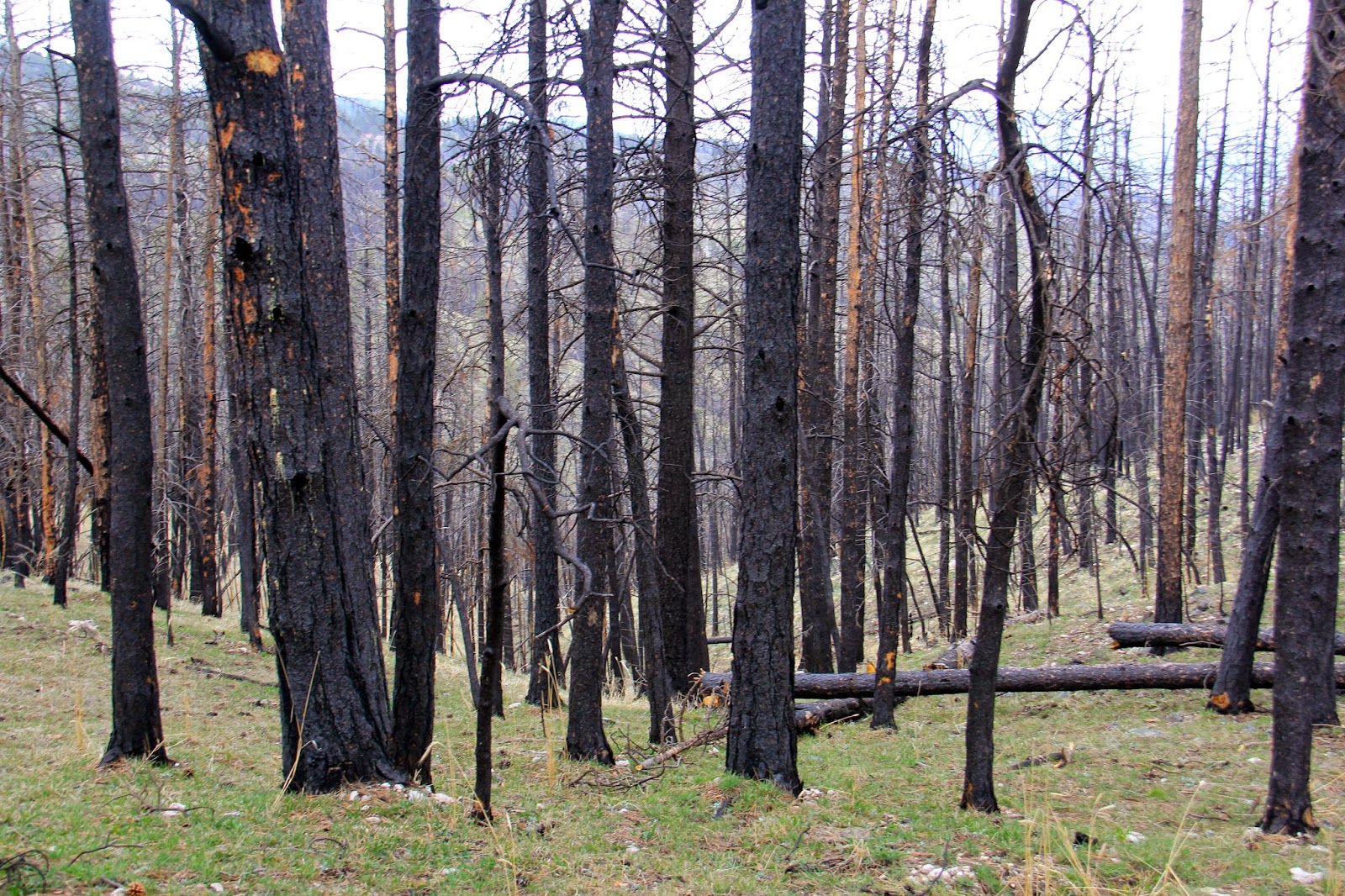
Hillside that burned during the High Park Fires of 2012 in Colorado.
This fire was started naturally via lightning strike, but is considered the third most
destructive fire in state history, destroying close to 250 homes. Photo by: Matt Brincka

Fire ecology is fascinating. Living in Colorado, fire season it is just a way of life for much of the year. Signs of wildland and forest fires have been found in petrified wood and the earth's strata from around 350 million years ago, so in no way is it a man-made phenomenon. Once humans learned to control fire, it was used for clearing land for agriculture, communication long distances, to prep food, keep warm, and during times of conflict.

Fire Triangle
Fire, or combustion, needs three things to burn: oxygen, fuel, and heat. Missing an ingredient? No fire. Improper preparation of ingredients? No fire. Fire needs at least 16% oxygen to burn. Thankfully... our air is 21% oxygen, which not only allows us to survive through respiration, but it also provides us fire.

Before humans learned how to ignite a fire, it was naturally caused by lightning and lava. Now, roughly 90% of all wildland fires with the United States are caused by humans, leaving only 10% of fires being ignited by natural causes. Not all human made fires are ignited on purpose. Negligence is a major factor in wildland fire ignition, including leaving campfires unattended and the improper disposal of cigarettes. Other causes of wildland fire include arson and prescribed burns.

Hiking through the Fern Lake burn scare in Rocky Mountain National Park.
Notice the lack of vegetation on the ground, even two years after the 2012 fire. This
fire was started by an illegal, high elevation campfire. Photo by: Matt Brincka

Benefits of Fire
Many ecosystems require fire to survive as productive and sustainable habitats for wildlife. Fires that naturally occur in ecosystems burn quickly and at a low intensity. This low intensity fire destroys plants above ground, but below ground their root systems are still intact. Since fire during natural cycles can return nutrients to the soil, the root systems thrive and often produce new growth with a few weeks. This tender new growth is full of nutrients, making it prime grazing habitat for herbivores.

The hillside by Cub Lake in Rocky Mountain National Park was burned during the
Fern Lake Fire in 2012. Though it looks scared now, the hillside will go through succession
and return to a beautiful forest. Photo by: Matt Brincka

When fire is 100% suppressed and their is a lack of the natural fire cycle, the risk of catastrophic fires increase greatly. These are the fires many people see on the news; roaring flames that often result in the loss of property and human life. Fire suppression was a very common practice before we truly understood fire dependent habitat. During that suppression period, fuel - flammable material such as wood - slowly built up until what was normally an average fire turned into a high heat, high damage burn. We are talking heat so hot that it destroys the habitat completely, destroying below ground root systems, leaving a barren wasteland. These high burn, high damage fires are often the ones we see which destroy homes as well.... and can lead to much sorrow.

Today, wildland firefighters still suppress fire, but not to the extent that we use to. The main goal today is to allow the fire to burn as much as we possibly can without it damaging property and harming lives. All fires are handled on a case-by-case basis. If they think the fire will be a low burn, firefighters may let it run its course, but still keep an eye on it. If the fire looks like it can get out of control or do damage, that is when you'll see the calvary (planes, helicopters, hundreds of firefighters) storm in.

Prescribed Burns
Being humans, we didn't like the randomness of wildfires. We, as a species, don't like random. We like to now what is coming our way. We don't want to wait an guess on where and when the next fire will come. There are instances where fuel build-up naturally occurs, even without fire suppression. Like during the suppression era, this build-up of fuel can lead to intense burns that threaten property. To try and prevent this, and to keep a natural cycle within certain habitats, we will actual conduct a prescribed burn. These prescribed burns mimic those low-intensity, quick burning fires that happen naturally. Prescribed burns can be used for other management practices, such as the removal of invasive species, but we won't get into that in this blog.

Fire Prevention
One of the largest social marketing triumphs for fire prevention lays at the feet of Smokey Bear (not Smokey The Bear... don't believe me?). Smokey's famous "only you can prevent forest fires" resinates throughout much of the population. The goal behind it isn't to say that "all fires are bad." The message is saying that human generated forest fires are not natural and that it is important that we both understand fire and actively try to prevent human-made fires. Remember, 90% of forest fires in modern society are human generated... that is an absurd number.

Smokey Bear

National Fire Danger Rating System
The National Fire Danger Rating Systems helps you and I understand proper care practices that we can do to help prevent human-made fires under different conditions. The color coded system is broken down into five categories, including Green (low), Blue (moderate), Yellow (high), Orange (very high), and Red (extreme). To learn more about each category and what you can and cannot do during each ranking, go to the National Park Service website.

It is important to know the benefits and dangers of wildland fires. Not all fires are dangerous and not all fires are bad. Fire is a natural force that humans have a history of mismanaging. It is important to not rely on firefighters to put out our erroneous fires. We, as citizens, need to take it upon ourselves to help prevents man-made fires... so fire can at least partially transfer back to its natural, habitat enhancing state.

What Can You Do?: Put Out Your Campfire!The following procedure on how to put out your campfire comes from Smokey himself.

  1. Allow the wood to burn completely to ash, if possible.
  2. Pout lots of water on the fire, drown ALL embers, not just the red ones.
  3. Pout until hissing sound stops.
  4. Stir the campfire ashes and embers with a shovel.
  5. Scrape the sticks and logs to remove any embers.
  6. Stir and make sure everything is wet and they are cold to the touch.
  7. If you do not have water, use dirt. Mix enough dirt or sand with the embers. Continue adding and stirring until all material is cool. Remember: do NOT bury the fire as the fire will continue to smolder and could catch roots on fire. This will eventually get to the surface and start a wildfire.
Do us a favor... when you leave camp, don't leave a campfire still hot... and it better not still be burning.


Sunday, July 20, 2014

Velkommen til Poulsbo: Nerdy Naturalist Makes a Move

Recently my wife and I made a major move in our lives... again.

Two years ago we found ourselves moving to Colorado from New York. We were recently married and thanks to my wife's uncle and aunt, we had a free place to live in Colorado. We love Colorado and were prepared to stay long term... but things don't always go as planned. The past few months have been very busy and a bit hard for new family. Colorado, in all its beauty, was starting to actually drag on us. We missed the trees. We missed water. We started to actually get into a little rut. The townhouse that we were renting went onto the market and the new owners didn't want to rent it after our lease was up. There were many variables in motion... so we decided it might be a good idea to spread our horizons and try finding career jobs.

My desired career path found its way to me first. I was offered a job in Kitsap County, Washington working in environmental outreach and extension.... so we moved! The past 2-3 months have been a whirlwind, but we are finally settled into our new home in Poulsbo, WA.

Poulsbo is a quaint little town on Liberty Bay across the Puget Sound from Seattle. Poulsbo has a strong scandinavian heritage and as you walk around the town... it shows. Viking statues, longboat reliefs on benches, and the flags of scandinavian countries flying proud.

Benches with a longboat relief in Poulsbo. Photo by: Matt Brincka

Liberty Bay Waterfront Park. Poulsbo, WA. Photo by: Matt Brincka

Washington will provide a whole new stomping grounds for pictures. In Colorado, for my job I was in front of a computer all day and I had a huge commute (1.5 hours each way). I found it hard to get myself motivated to type within the Nerdy Naturalist blog-o-sphere. I actually found it hard to export pictures from my camera to my computer for editing. I was exhausted constantly.  I'm not making excuses... but it was a quality of living that didn't allow me to complete the things that I love.

So far we are loving Washington. My commute is smaller. I'm in a field that I went to school for and I love. I'm not sitting in front of a computer all day. Overall, I can already feel the quality of living increased drastically.

I'm hoping to get onto a more regular routine with my picture taking and my posts. I know I've said that in a few of my past posts, but life was strange then. Life is better now. Until the next post... enjoy some pictures of Poulsbo.

A view of Liberty Bay. Photo by: Matt Brincka

Picnic place. Photo by: Matt Brincka 

Poulsbo's boardwalk. Photo by: Matt Brincka

Harbor seals are a common site within the Poulsbo marina.
Photo by: Matt Brincka

Poulsbo marina with some pre-sunset color.
Photo by: Matt Brincka


Wednesday, May 28, 2014

Spring Babies

Ahhh... spring. The season of babies. Everywhere I turn I seem to see the signs of fertility in nature. Baby geese. Baby owls. Baby deer. Baby prairie dogs. Baby trees. Baby fish... whatever it is, there are babies running rampant. Spring births are very common in the natural world. Spring brings longer, warmer days and an increase in food supply: the perfect combination for rearing young. Baby animals are adorable (of course)... so lets enjoy some cute baby animal pictures!

p.s. I have a few articles finished or in the works and should be posting them over the next few months. I didn't have the time I hoped for this spring to write, but the horizon looks good! For now, enjoy some baby animal pictures!

A fawn mule deer showing curiosity. Photo by: Matt Brincka

A baby donkey bonding with its companion. Photo by: Matt Brincka

A great-horned owl with her owlets. Photo by: Matt Brincka

A young elk starting to lose its spots. Photo by: Matt Brincka

A nanny mountain goat with her kid. Photo by: Matt Brincka

Two twinnie mountain goats... with some sass. Photo by: Matt Brincka

Some new born geese taking an adventure from the tall grass. Photo by: Matt Brincka

Even the baby geese know the V-formation. Photo by: Matt Brincka

Some baby geese grazing on some spring wild flowers. Photo by: Matt Brincka

Friday, April 11, 2014

Natural Playscapes

Last year I was approached by a friend for my permission to use one of my pictures on an interpretive sign as part of a nature playground in Clark's Reservation State Park in New York. This was the first time I had ever been approached to use my pictures professionally, so it was truly exciting and a great honor.

The sign that used my picture of a sub-alpine fir
immature pine cone (top right). Photo by: Elisabeth Holmes

That natural playground is now complete and the interpretive signs are up and all I have to say is that they are beautiful. My friend and past classmate, Elisabeth Holmes, did an amazing job with designing the plaques and sculpting fossils within the cement walkway.  I can't wait to make it back to see them in person.

The playground itself is chock-full of awesome interpretive signs and nature-based play structures. Nature playscapes are a great alternative to the mundane, over-used plastic and metal playground equipment. The idea of playgrounds is a sound foundation, for children of all ages need to be active outside. Plus, with the rise of electronics, there is a growing culture concern about young generations losing touch with nature. Natural playgrounds and playscapes meld the desire to have designated play areas in a natural setting. They aren't as good as playing in the woods, but they are far better than a cookie-cutter slide and swings from The Home Depot.

Below you will find more pictures of the Clark's Reservation State Park modified natural playground. It isn't a full-blown naturescape, but it is a brilliant attempt step to connect younger generations with nature.

The natural playground at Clark's Reservation State Park.
Photo by: Elisabeth Holmes

Fossil imprints. Photo by: Elisabeth Holmes

Friend otter. Photo by: Elisabeth Holmes

A climbing course/tunnel with one of the interpretive poles.
Photo by: Elisabeth Holmes

One of the interpretive poles. Photo by: Elisabeth Holmes

A climbing wall with a interpretive pole. Photo by: Elisabeth Holmes

Sunday, March 23, 2014

Tumbleweed: Supplemental Videos

After writing about tumbleweed last week... this brilliant video was posted on YouTube.


When something like this happens, communities usually rely on heavy machinery to move everything out of the way. Such a simple plant can cause a giant headache.


Monday, March 17, 2014

Tumbleweed: A Symbol of the American West... or is it?

You know what tumbleweed is. It is that brown ball that crosses the barren expanse between a dueling outlaw and the sheriff in Western films. It is a symbol of emptiness and the desolate that was, and sometimes still is, of the American West. Without it, how could Hollywood state that there is absolutely nothing anywhere! See that tumbleweed? That means this town is abandoned! See that tumbleweed? Someone is going to die in this pistol fight!

The funny thing is... the tumbleweed we know here in the US isn't actually suppose to be here... because it is an invasive species! On windy days it crosses your path constantly while driving down I-25 in Colorado. It just keeps rolling and rolling and rolling.... until it hits a fence. Tumbleweed didn't show up in America till the late 1800s. Its true name? Russian thistle. It is believed that some stowaway seeds found their way into a shipment of flax seeds to South Dakota from Russia.

Fences... a tumbleweed's un-natural enemy. Photo by: Matt Brincka

Now Russia thistle is considered a noxious weed, out-competing native species for the scarce amount of water these ecosystems provide. Essentially, this invasive is turning the habitat it lives in into a mono-culture, effectively producing large plots of land unavailable for grazing animals, both livestock and wildlife.


This pile of tumbleweed is roughly 6-8 feet high... that is a lot of tumbleweed.
Photo by: Matt Brincka


Tuesday, February 11, 2014

Surviving the Cold, Part 2: Plants

While living in a temperate climate, when the temperature starts to plunge amazing behavioral changes occur in all forms of life. Winter is often seen as a bare, lifeless landscape... when in reality, life still surrounds us!

This is part two of multi-part series that look into adaptation and coping mechanisms plants and animals use to survive cold weather. Last time we looked at some brilliant survival techniques birds use during the frigid winter months. Today, however, we are focusing on...

PLANTS!

Plants... they truly are life-giving organisms. The spring and summer months are full of color. Greens of grasses and trees mix with the vibrant colors of flowers. Not only do they bring us visual joy, but they also provide the oxygen we need to survive.

Plants are natural survivors. All they really need are some nutrients from the soil, water, and sun and they do pretty well OK on their own. In the winter, however, many plants have a rough life. The days are too short to provide them with enough sunlight and the cold air makes growth nearly non-existent. Sometimes the weather gets so cold water freezes. Roots are great tools to absorb liquid water... but ice? Forget about it. These harsh conditions would kill any plant if they didn't have special adaptations for surviving those long, cold, dark winter months.

Many perennial plants, including scrubs and trees, drop their leaves in the winter.
Photo by: Matt Brincka

How cold kills
Before we get into adaptations, we should first figure out how cold weather actually kills plants.

Picture this for me... Imagine if you had to stand outside all winter long, couldn't move, and were completely naked. Think you could last long? I sure couldn't. This is essentially what perennial plants (plants that live more than two years) go through in the colder areas of our globe. Annuals are a whole different picture... which we will cover later.

There are a few ways cold weather can kill a plant. First, the water inside a plant's cells could freeze. Ice takes up more space than water. Ever put a can of soda in your refrigerator for too long and it explodes? That is kind of what happens to a plant's cells when they freeze. Ouch.

Another way cold can kill a plant is when water in intercellular spaces (area outside and between plant cells) freezes. This process actually leads the plant to dehydrate, a similar effect of a plant that is experiencing a drought.

Both of those conditions can kill plants very quickly. Cold-temperatures do have other effects on plants besides the freezing of water. If an extremely warm area, like Florida, experiences unnaturally long periods of cold weather but remains about freezing could see many of their plants start to wilt and die. That is because the cold weather is doing one or both of two things: 1) the fluidity between cell membranes change preventing nutrients from entering and exiting the cells at a normal rate, or 2) the cold weather decreases the enzyme activity in the plant, effectively reducing the metabolism of the plant, meaning the plant isn't receiving the energy it normally needs to survive and, thus, is causing a lot of harm... both of which can lead to the demise of our leafy friends.

On to the adaptations!

Dropping leaves
Believe it or not, but the changing of colors and dropping of leave of deciduous trees and shrubs is a winter weather survival technique! Not to mention they look rather pretty. When a tree drops all its leaves, it does so to prevent water loss from inside the plant.

Most conifers keep their needles year-round, only developing their cones
once warmer weather arrives. Photo by: Matt Brincka

The solution is the solution (cell solute levels)
When we salt our front walk in the winter, the salt dissolves with the ice forming a solution and effectively lowers its freezing point... which means it could be 30 degrees outside but ice won't form on your walkway. Plants essentially do that say thing... but normally with sucrose (sugar) and other organic compounds. By increasing the solute levels in the water found in their cells, plants can actually depress the freezing point of water and stabilize their membranes. The only problem is if it gets too cold that sugar water will ultimately freeze itself.

Antifreeze
Some plants are masters at surviving subzero environments. These plants typically develop a type of protein that acts like antifreeze. The proteins are normally excreted by the cells that make them into the cell walls, preventing the freezing of intercellular and extracellular spaces.

Dehydrins
Dehydrins are found in a lot of drought tolerant plants, but they are also found to help plants in the cold as well. Dehydrins act as a cryoprotectant, meaning they help protect biological tissues from freezing. Cryoprotectants are very coming is arctic and antarctic insects, fish, and amphibians. Many cold-weather plants (i.e., alpine plants) also have to deal with extreme dryness as well, so the dehydrins help not only with the cold weather, but they make the plant more drought tolerant as well.

Lipids
Some plants' cells can actually change their cellular membrane lipid (fats, waxes, etc) composition. This alteration allows for the adjustment of fluidity in colder temperatures.

Storage organs
Tree and shrubs are noticeable perennials. The reminder that spring will be here soon. Some perennials are less noticeable because their shoots and leave we know die back every winter. Below ground, it is a different story. Some plants utilize underground storage organs where they store food reserves through the growing season. When spring comes, those reserves are used to grown fresh shoots and leaves. There are a few different storage organs, namely tubers (i.e., potatoes), tap roots (i.e., carrots), and bulbs (i.e., onions). Many trees are also known to send their energy supply (sap) to their roots during the winter for storage until spring comes again.

Annuals
Not all plants survive the winter months. Plants that live for one growing season or shorter and die when winter comes-a-calling are called annuals. Annuals rely on their progeny (seeds) to carry on their legacy! Seeds are fairly hardy. When planting annuals there is typically a warning to plant the seeds after any danger of frost. That warning typically isn't for the fear of seeds dying, but rather for the fear of seedlings dying! Often annual plants just have to wait for the right conditions for their seeds to sprout, which can be a combination of soil temperature and texture, soil moisture level, and enough light. Sometimes seeds can lay dormant for years before sprouting! Annual plants are shown to distributed in that have predictable habitats with regular cycles. Annual plants that live in unpredictable habitats, such as deserts, have been shown to have seed adaptations with complex dormancy cycles in which they are ready to sprout in a variety of different conditions instead of just the perfect scenario.

Alpine plants have not only developed adaptations for extreme cold, but for
ultraviolet radiation, dryness and an extra short growing season.
Photo by: Matt Brincka

Is that all?
These are just a few common cold weather survival techniques plants use. There are countless studies focusing in on survival techniques of plants in extreme weather. Do be afraid to read up on some of them yourself!

What can we do?
Humans are notorious for bringing non-native plants to their gardens and patios. Many native plants already have the adaptations in place to survive the winter your area naturally experiences. However, if you are worried about your plants... here are a few things to consider.
  1. Bringing your plant pots inside during the winter
  2. Overwintering your fragile and tender bulbs
  3. Take cuttings of specific plants
  4. Winter mulching (an interesting way to keep the ground frozen in the winter... which can be important)